
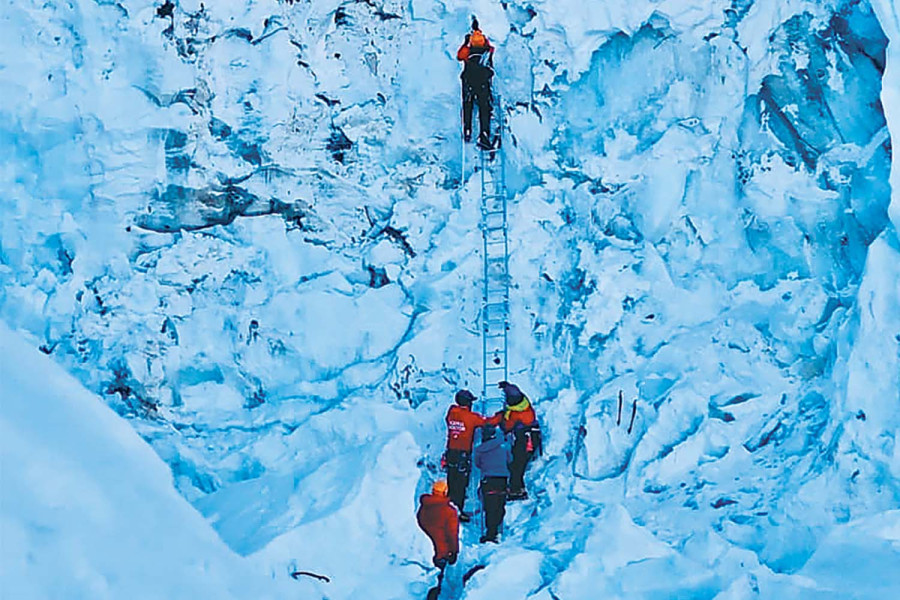
For the more than 400 climbers who have spent nearly three weeks waiting anxiously at Everest Base Camp, April 29, 2026, brings the news they have been watching the horizon for: the Khumbu Icefall route is open.
Nepal's Department of Tourism confirmed on Tuesday that experienced high-altitude climbing guides and the legendary Icefall Doctors have successfully established a passage through one of the most dangerous sections of the world's most dangerous mountain approach ending what has become one of the most challenging and prolonged route-preparation delays in recent Everest history.
But this is not a clean all-clear. The route passes directly beneath a massive, cracked serac that authorities describe as capable of collapsing "at any time." Strict safety protocols are now in effect. The 2026 spring season is open, and it will require every climber on the mountain to move with discipline, speed, and respect for a hazard that has not been eliminated, only navigated.
What Caused the 19-Day Delay?
The Khumbu Icefall, the 600-meter section of shifting glacier between Base Camp (5,364 m) and Camp I, is the most objectively dangerous portion of the standard Everest South Col route. Every spring, a team of elite high-altitude workers known as the Icefall Doctors begins fixing ropes, installing aluminum ladders across crevasses, and establishing the safest possible path through an environment that moves, shifts, and collapses daily.
This season, an unusually large and structurally unstable serac, a towering wall of glacial ice, blocked forward progress entirely and halted all route preparation beyond a critical point.
According to data from the Sagarmatha Pollution Control Committee (SPCC), the serac that caused the obstruction measured approximately 55 metres in length, 37 metres in width, and 28 metres in height, a mass of ice equivalent to a large building, positioned directly over the only viable passage between Camp I and Camp II.
The Icefall Doctors had initially begun route preparation on March 16, 2026, and had secured a safe passage up to what is referred to as the "rockfall point" by April 8. After that date, the serac made further progress impossible for 19 days. Multiple site inspections and drone imaging sessions monitored the formation through this period. A portion of the serac collapsed during monitoring, but the remaining mass stayed in place, as unstable as before.
How Was the Route Finally Opened?
The breakthrough did not come from a single dramatic moment. It came from a coordinated, methodical effort under extreme pressure as the narrow spring summit window began to close.
A joint helicopter inspection was conducted on April 25, followed by a ground-level site visit on April 26. Both assessments confirmed that severe risks remained at the location and that no completely safe path existed. This is the critical reality that climbers must understand: the serac was not removed, neutralized, or declared safe. The route was opened below it because no viable alternative existed.
Before the SPCC's official solution, Mingma G led an independent team that attempted to establish an alternative path on April 25. His team's approach involved climbing above the serac via a near-vertical wall, a route requiring approximately 10 vertical ladders on unstable ice formations. After assessment, the SPCC and Icefall Doctors ruled this option too dangerous for the volume of climbers, the loads being carried, and the unpredictable nature of the ice structure.
"After ruling out the vertical route suggested by the Mingma G team, our Icefall Doctors explored an alternative path through the centre of the section, but no safer option could be identified," the SPCC stated.
On Tuesday, April 28, eight Icefall Doctors together with 16 mountain guides from various expedition operators departed Base Camp and successfully opened the route, passing below the serac and reaching close to the Nuptse face, the approach to Camp II. The team returned to Base Camp safely at approximately 4:00 PM the same day.
By Tuesday, route setters had established a track leading close to Camp II, a critical milestone that unlocks full acclimatization rotations for the teams waiting below.
The Current Situation on the Mountain
Nepal's Department of Tourism had issued Everest climbing permits to 425 climbers as of Monday, a strong turnout that reflects sustained global interest in Everest despite the permit fee increase to USD 15,000 per person that took effect in September 2025.
These 425 climbers, together with a large number of Sherpa support teams, have been grounded at Everest Base Camp due to the delay. The psychological toll of 19 days of waiting, with fitness slowly declining, weather windows passing, and the ever-present logistical drain of high-altitude accommodation should not be understated. For many teams, the delay has already compressed the margin they budgeted for multiple summit attempts.
This timeline matters enormously. If summit route fixing reaches the top by approximately May 8–10, the first viable summit windows open around that date, consistent with the historical spring window. If delays compound further due to weather, serac activity, or logistical bottlenecks, available summit windows narrow significantly before the monsoon arrives in late May or early June.
Ram Krishna Lamichhane, Director General of the Department of Tourism, confirmed the route progress but noted the knock-on effects of the delay.
"After a few days, climbers will begin acclimatisation rotations moving up and down the mountain to allow their bodies to adjust to altitude," he said, adding that authorities have recommended boosting manpower deployment and ensuring timely logistics delivery to accelerate the summit-route fixing schedule.
The Safety Protocols Every Climber Must Now Follow
Despite the route being open, the SPCC has been explicit: the risk at the rockfall point has not been eliminated. The serac that forced 19 days of delay remains in place, structurally compromised, and capable of collapse without warning.
In response, the SPCC has issued mandatory safety protocols for all climbers and expedition operators passing through the affected section. These protocols are not suggestions:
Move quickly through the rockfall zone. Minimizing time beneath the serac reduces exposure. No protocol makes the zone safe, only faster.
Limit loads carried by high-altitude workers through the section. Heavier loads slow movement. The rockfall zone is not the place to carry full supplies in a single carry.
Only one person crosses a ladder at a time. Multiple people on a single ladder increases both weight and time-on-ladder exposure.
Remain clipped into safety ropes on both sides while traversing ladders. This is standard Icefall protocol, but it is being reinforced specifically for this section.
Report all incidents immediately via radio frequency 144.200. Emergency communication is the first response in the event of any serac or rockfall event.
Eight ladders have been installed across three key sections of the affected zone. The SPCC has noted that additional ladders will be required as crevasses continue to widen with rising temperatures, a seasonal reality that makes the Icefall increasingly unstable as April becomes May.
Drone logistics support is also in operation. Milan Pandey, co-founder of Airlift Technology, confirmed that four aluminum ladders and five rolls of rope were delivered via drone to Camp I on Tuesday, with the company on standby to deliver oxygen cylinders and other essential logistics as required.
Why This Delay Matters Beyond 2026
The Khumbu Icefall is the single most objectively dangerous section of any commercial climbing route on Earth. It is also the feature that makes the Everest South Col route simultaneously accessible and lethal.
The history is stark. On April 18, 2014, a serac collapse triggered an avalanche that killed 16 Sherpa guides in the Icefall, the deadliest single incident in Everest's history at that point, and forced the cancellation of the entire 2014 spring season. More recently, on April 12, 2023, three Sherpa guides were killed in another avalanche triggered by a massive icefall collapse in the same general area.
The 2026 season is now defined, in its early weeks, by the same fundamental tension: the Icefall is the only path to the world's highest summit, and it cannot be made safe, only managed.
The 19-day delay of 2026 will likely accelerate industry and government conversations about several structural questions:
Can drone logistics reduce the number of Icefall crossings required by high-altitude workers? The Airlift Technology drone supply operation, active this season, is a direct response to this question. Every ladder or rope spool delivered by drone above the Icefall is one less carry required from a Sherpa crossing the rockfall point.
Should the season start date or route preparation timeline be adjusted in future years? The Icefall Doctors began work on March 16. The serac blocked them for 19 of the 44 days between then and late April. At what point does the season calendar need to adapt to changing glacier conditions?
How does accelerating glacier movement driven by broader climate-related changes in the Himalaya affect long-term route viability in the Khumbu Icefall? This is not an abstract question. The Icefall moves approximately 1 metre per day, but its overall character is changing season by season as higher average temperatures affect the stability of its ice towers and serac formations.
What Happens Next: The Path to Summit Day 2026
With the route now open to near Camp II and acclimatization rotations set to begin within days, here is the realistic timeline for the 2026 spring season:
April 29 – May 2: Camp I and Camp II established by operator teams. Acclimatization rotations begin when climbers move to Camp I and return to Base Camp to stimulate physiological adaptation.
May 2 – May 8: Route fixing teams push from Camp II up the Lhotse Face toward Camp III and Camp IV (South Col). Teams continue acclimatization rotations to Camps I and II, then I through III.
May 8 – May 10 (estimated): If route fixing proceeds as projected, the complete summit route to 8,848.86 m should be established. First summit weather windows may open in this period.
May 10 – May 25: The primary summit window. Teams will time their summit pushes from Camp I to Camp II to Camp III to Camp IV (South Col) and then the overnight start for summit day around weather windows provided by professional meteorological forecasting services.
Late May: Monsoon onset. Any team that has not submitted by late May faces rapidly deteriorating conditions. The season ends, Base Camp is dismantled, and the mountain returns to silence.
The 19-day delay has not destroyed the 2026 spring season. The math remains viable. But it has compressed margins that many teams had built into their planning, particularly those hoping for multiple summit attempts or those for whom the specific summit window timing is constrained by permit, insurance, or flight booking dates.
For Climbers and Families Watching From Afar
If you have a team member, friend, or family member currently at Everest Base Camp, the opening of the Icefall route is genuinely good news, and it comes with an honest context.
The mountain is accessible again. The season will proceed. The Icefall Doctors and the expedition operators have done extraordinary work under genuinely difficult conditions to make this possible. The drone logistics support, the joint helicopter assessments, and the coordinated ground operations all of it reflects an industry that has invested significantly in improving safety outcomes despite working in an environment that will never be fully safe.
What has not changed: the serac above the rockfall point remains. Every crossing of the Icefall this season will require discipline, speed, and adherence to the SPCC protocols. Teams moving through the rockfall zone before dawn, when colder temperatures keep the serac structure most stable, are making the right call.
Trust your guides. Respect the protocols. Move fast through the danger zone. And support the Icefall Doctors who open this route every year in service of a dream that belongs to climbers from every country on Earth.
Key Facts: Khumbu Icefall and the 2026 Delay
- Route delay: 19 days, from April 8 (when the serac blocked progress) to April 28 (route officially open)
- Serac dimensions: ~55 m long × 37 m wide × 28 m high
- Permits issued: 425 Everest permits as of April 28, 2026
- Teams affected: 400+ climbers at Everest Base Camp, plus Lhotse and Nuptse expedition teams
- Route now established: Base Camp to near Camp II (Nuptse face approach)
- Estimated time to complete summit route fixing: ~10 more days
- Safety requirement: Mandatory SPCC protocols at rockfall point; radio frequency 144.200 for emergencies
- Drone supply active: Airlift Technology delivering ladders, rope, and oxygen to Camp I
- Historical context: 2014 Icefall avalanche killed 16 Sherpas and cancelled the season; 2023 Icefall collapse killed 3 guides
- First summit window: Estimated May 8–10 if route fixing proceeds on schedule
|
Planning a Trip? Get a free consultation from our travel experts with over a decade of experience. |

Himalaya King
Manager
Adventure Awaits — Let’s Begin Your Journey


