
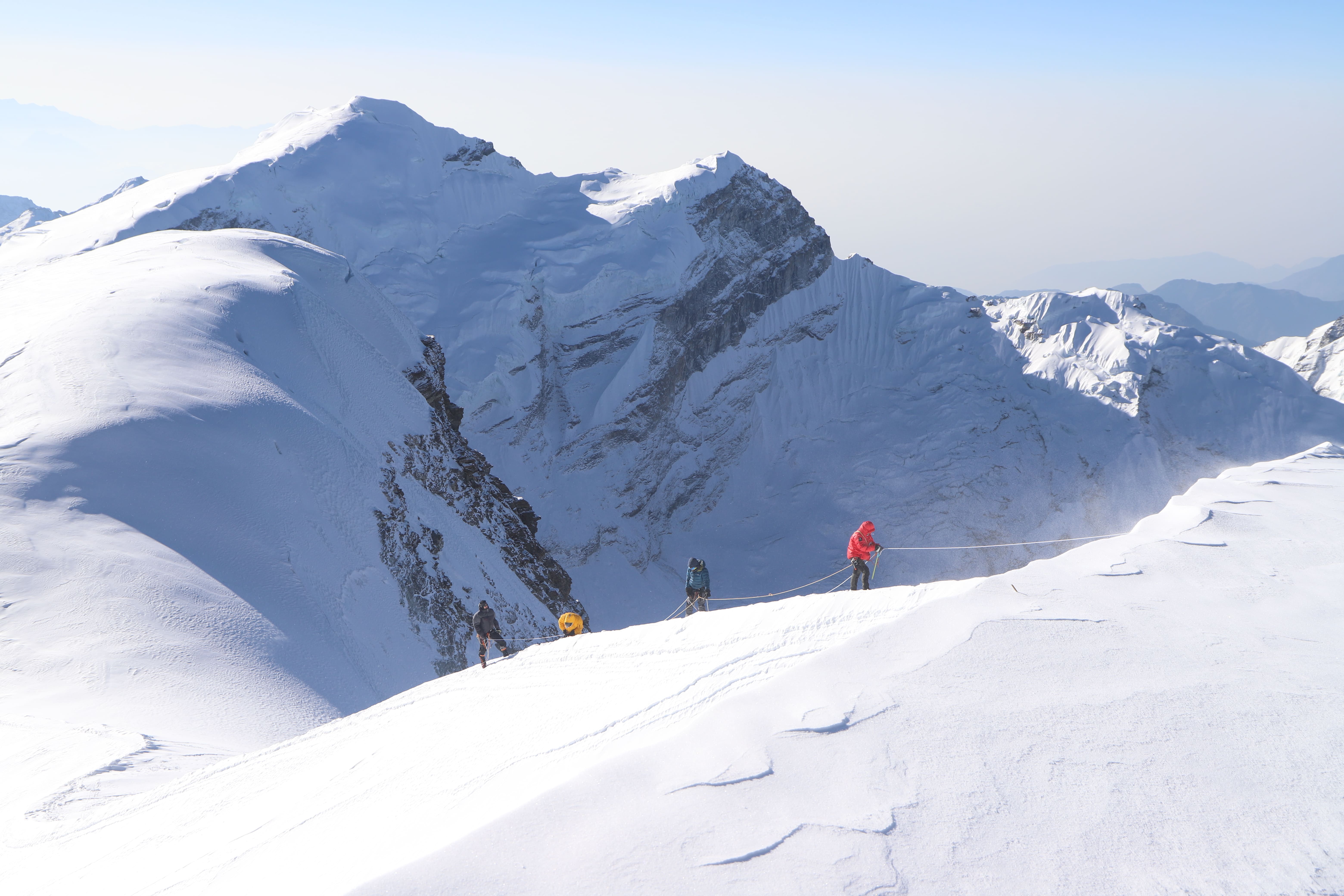
Mera Peak is situated in Solukhumbu District and is known as the highest trekking peak of Nepal. Mera Peak stands at 6,461 meters, and it is a popular choice for climbers because of its less technically challenging nature, making it suitable for beginners who want to experience a high-altitude expedition. Mera Peak offers breathtaking views of the surrounding mountains. The ascent mostly involves walking on snow and glaciers, with fewer steep rock sections compared to many other peaks. The route through the Hinku Valley in Solukhumbu allows climbers to acclimate gradually, helping their bodies adjust to the altitude. Many climbers use Mera Peak as their first 6,000-meter climb before pursuing higher peaks like Mount Everest or Ama Dablam. These climbs involve trekking through diverse landscapes to alpine meadows and rugged glacial terrain. Mera Peak offers breathtaking views of Mount Everest, Mount Lhotse, and Mount Cho-Oyu. Climbing Mera Peak not only tests your endurance and skills but also immerses you in the rich Sherpa culture and stunning natural beauty.
Is Mera Peak beginner-friendly?
Yes, if you are looking for the best peak for your first time, then Mera Peak is more beginner-friendly than other peaks. However, it is still a serious climb, so preparation is essential before the expedition. Beginners are highly advised to climb with an experienced and professional company, Himalaya King Trekking and Expedition, which provides highly skilled and expert guides with quality gear and a well-planned acclimatization itinerary. The climb mostly involves walking on snow and glacier terrain. Only basic mountaineering skills are required, such as using crampons, ropes, and an ice axe. The approach through the Hinku Valley in Solukhumbu allows climbers to acclimatize slowly. Mera Peak is a good training peak for beginners who want to try another of the highest peaks in upcoming day.
Why is Mera Peak considered the easiest Peak?
Mera Peak is considered the easiest 6,000-meter peak because it is less challenging than other 6,000-meter peaks, making it a good choice for beginners. Mera Peak is an ideal peak for beginners who want to combine both trekking and climbing without extreme challenges. Mera Peak is a trekking peak that offers the most rewarding views from the top and along the route. The reasons that Mera Peak is considered the easiest peak are:
You will get trekking and climbing experience: In the Mera expedition, you will have both the experience of trekking, hiking, and climbing at once. The trekking of a multi-day immersion into nature makes your journey more wonderful. It tests your endurance through long hours of walking/hiking across changing landscapes and remote villages with the blooming Rhododendron along the trail, keeping you encouraged to explore more. In trek, you can experience the different cultures of different places in Nepal. In a climbing phrase, you can experience basic climbing skills with a technical challenge focused on reaching a specific summit. Mera Peak doesn't demand technical challenge, but it demands physical and mental strength. Mera Peak is the best option to choose for training and for beginners with less technical challenge.
High success rate: Mera Peak has a high success rate for beginners with less technical challenge in a high-altitude peak. Success is most often determined by proper acclimatization, Physical fitness, and proper preparation before an expedition with stable weather. The success rate of Mera Peak is between 90% to 95%. Choosing the Mera peaks can be the best decision to climb the high peak with basic skills of mountaineering, or for beginners.
Non- technical Peak: Mera Peak doesn't require mountaineering experience to climb. For Mera Peak, you can learn basic skills before the expedition, like using crampons, a jumar, carabiners, and ropes, and so on. Mera Peak is considered for high altitude peak with a non-technical challenge. Mera Peak helps to improve your mountaineering skills for further high-altitude peaks.
From the Tea house to the Tents experience: Mera peaks offers rewarding views with a different experience from the Tea house to the Tents. In this expedition, the treks begin through inhabited valleys, where you can stay in a tea house. Once you leave the last village and enter the basecamp and high camp, everyone has to stay in a tent because there is no village or teahouse. The Basecamp team will manage all accommodation and Meals in tents at Basecamp and High camp during the climbing and training period. Tents experience offers a quiet, focused, and intense vibe in Basecamps and Highcamp.
True Himalayan Experience: Mera Peak offers a true Himalayan adventure experience. This trekking peak offers the most rewarding views of Mount Everest, Lhotse, and Cho-Oyu. Mera Peak is the best choice for beginners and those who want a less crowded high-altitude peak climbing experience.
High altitude with fewer technical challenges
Mera Peak is the best option for beginners to experience high-altitude mountaineering for the first time. Mera Peak is higher than Island and Lobuche Peak and Mera Peak have fewer technical challenges compared to Lobuche and Island Peaks. Even fewer technical challenges demand physical effort. Before expedition preparation is necessary to ensure your safety. Success isn't about summiting Mera Peak; it is about summiting with safety. For Mera Peak, you don't need experience, but you need to know how to use crampons, carabiners, and ropes.
Remote area and Less crowded
Mera Peak is located in the remote Hinku Valley. It is a less crowded area, perfect for those seeking a peaceful trek. The mountain is in the Hinku Valley of Solukhumbu, which has far fewer villages than popular trekking routes. Most climbers fly into Lukla and then trek for several days to reach the base camp. The routes often lead to traditional Sherpa and Rai villages with ancient monasteries and blooming Rhododendron flowers along the trail during the spring season. There are a few lodges, shops, or medical posts along the route. Expedition companies provide their own food, tents, and equipment. Mera Peak is ideal for adventure lovers and offers a truly unique experience.
Best time for the Mera Peak expedition
The spring season and the autumn season are the most popular and the best seasons for the Mera Peak Expedition. In the winter and summer seasons, going on an expedition is not safe for everyone. These two seasons are the best and safest seasons for an expedition. Many climbers choose them because they offer breathtaking views of the Himalayas without needing technical skills. The right season helps to make your trip successful and safe, with unforgettable memories.
Spring Season
The spring season (March to May) which is a warm and suitable time in the mountains. In this season, the day gets longer, the temperature rises, and the trails come alive with blooming Rhododendron flowers, fresh greenery, and clear skies. The spring season is the peaceful season with gentle weather that helps your body adjust to the altitude.
Why choose the spring season for an expedition as a beginner?
1. Stable and warm weather for the expedition
2. Clear skies
3. Low risk of avalanche and heavy snow
4. More visibility of the peak and the landscape
5. Safer trails
6. Less wind and a calm morning
7. Perfect time for training climbers for beginners
8. High success rate of Summiting Mera Peak
Autumn Season
Autumn season (September to October) is warm and calm, with beautiful season. The monsoon rains clear the dust and haze, which makes the air fresh and the views clearly sharp. During the autumn season, the paths dry, and it gives you time, and the skies remain clear with pleasant temperatures. It makes expeditions and treks more comfortable on longer days of walking.
Why choose the autumn season for the Mera Peak expedition?
1. Stable, warm, and clear weather
2. Comfortable during a daytime hike
3. Clear visibility of Peaks and the landscape along the trail
4. Less wind and safer trails
5. Low Risk of heavy snowfall and Avalanche
6. Experience Nepali festivals with a different culture
7. High success rate of Mera Peak summit
8. Blooming Marigold flower along the trail or tea house
Summer and Winter Season
The summer season (June- August) is a monsoon season, and the winter season (December-February) is an extremely cold season. We don't recommend both seasons for an Mera Peak expedition due to its challenging nature and for your safety. In the summer season, there is a high chance of having heavy rainfall in lower altitudes and unstable snow in high altitudes, which increases the risk of avalanches in high altitudes. During the winter season, the temperature at high altitude is much lower than zero degrees in high camp, which can increase the risk of frostbite, Altitude sickness, cold, and other challenges. In winter, snow can be deep, making climbing a dangerous affair. Days are short during the winter season. For most of the climbers, beginners and experienced, the cold and unpredictable weather makes winter and monsoon a tough season for the Mera Climb. Avoiding the summer and winter seasons keeps you safe from the most hazardous seasons.

Himalaya King
Himalaya King
Adventure Awaits — Let’s Begin Your Journey


