
Lhopshu: The Sacred Sanctuary of the Mountain Puja Before the Ascent
Before crampons bite into blue ice, before oxygen regulators hiss against the freezing air, and before the first rope is fixed across a gaping crevasse, there is a profound silence at Base Camp. In Himalayan mountaineering, physical preparation: the acclimatization rotations, technical training, and gear checks - is only half the equation. The other half belongs entirely to the spirit.
For generations, the indigenous Sherpa people of the Solukhumbu and high Himalayan valleys have viewed these giant peaks not as passive geological landforms to be conquered, but as Beyul - sacred, living sanctuaries governed by powerful guardian deities. Among the many spiritual traditions that underpin high-altitude expeditions, Lhopshu (more widely recognized in expedition culture as the Lhasang or Lhabsang solemn ritual, which forms the core of the mountain Puja) is the sacred bridge between human ambition and divine permission.
It is the ceremony that converts a commercial camp into a sanctuary and turns an act of intrusion into a humble request for safe passage.
1. The Divine Landscape: Living in the Shadow of Miyolangsangma
To understand the necessity of Lhopshu, one must look at the mountains through the lens of Tibetan Buddhism. To the Sherpa community, Mount Everest is Chomolungma, home to Miyolangsangma, the Goddess of Inexhaustible Giving. Ama Dablam is the motherly deity carrying the box of sacred jewels, and Kanchenjunga shelters the five treasures of the snow.
Entering these high, hazardous environments without ritual cleansing is considered spiritually reckless. The mountains are realm-spaces belonging to local spirits, guardians (Lha), and earth deities (Lu). Humans, carrying the energetic impurities of the secular world, must perform rituals of purification and appease these protectors before stepping onto the glaciers.
Lhopshu represents this sacred transaction: asking for forgiveness for cutting the ice with crampons, driving ice screws into the mountain’s body, and seeking protection from rockfalls, avalanches, and hidden crevasses.
|
Ritual Element |
Material / Form |
Symbolic Meaning |
|
Sacred Chorten / Stone Altar |
Stacked glacial stone altar with a central pole (Lharze) |
The spiritual epicenter of the Base Camp setup and focal point for the deities. |
|
Sang Smoke |
Burning green juniper branches and dry herbs |
Deep ritual purification of the campsite, technical gear, and the minds of the team. |
|
Lungta Flags |
Five-colored prayer strands (Blue, White, Red, Green, Yellow) |
Releasing prayers, positive karma, and peace into the atmosphere via the wind. |
|
Tsampa & Offerings |
Barley flour (tsampa), butter sculptures (torma), and chang |
Acts of devotion, nourishment, and respect offered to the mountain guardian spirits. |
2. Setting the Stage: Constructing the Altar at Base Camp
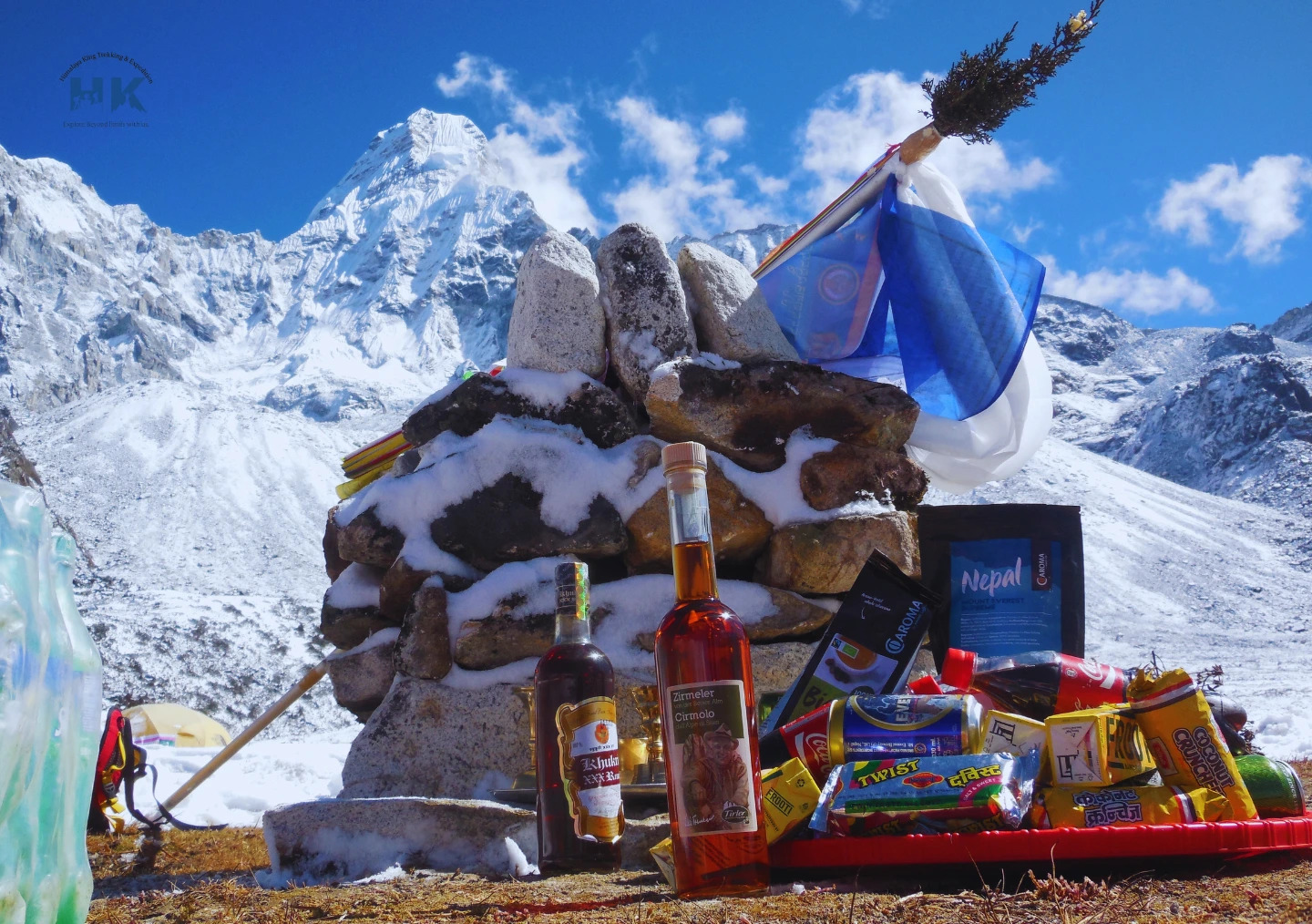
Long before the ceremony begins, the foundation of Lhopshu is set at the heart of Base Camp. Sherpas and expedition members build a central Chorten - a square stone altar stacked from glacial rock, facing toward the mountain.
At the center of this altar stands a tall wooden pole (Lharze). Surrounding it are intricate offerings painstakingly prepared by the Lama and senior Sherpas:
➢Torma: Sculpted ceremonial cakes made from tsampa (barley flour) and butter, colored red and white to represent spiritual nourishment and divine presence.
➢Sang (Incense offerings): Freshly cut juniper branches, rhododendron leaves, and dried herbs placed atop smoldering embers to create dense, aromatic white smoke.
➢Food & Drink: Bowls of rice, butter, fried dough (khapse), fruit, and containers of chang (barley beer) and tea.
➢Ghee and Butter Lamps: Lit to symbolize the illumination of wisdom dispersing the darkness of ignorance on the trail ahead.
Connecting the Chorten to surrounding tents and rock cairns are long strands of Lungta - the five-colored prayer flags (Yellow for Earth, Green for Water, Red for Fire, White for Air, and Blue for Space). These flags are left draped across the camp, waiting to be blessed.
3. The Anatomy of the Ritual: Smoldering Juniper, Chants, and Blessing
On the morning chosen by the Lama based on the Tibetan astrological calendar, the entire camp gathers around the Chorten. Commercial clients, international mountain guides, high-altitude workers, and kitchen staff sit side-by-side on wool blankets or rocks. All technical gear - crampons, ice axes, boots, ropes, and harness kits—is brought out and piled around the base of the altar to receive the divine blessing.
|
Step |
Phases |
Primary Action & Elements |
Purpose & Cultural Significance |
|
1 |
Sang Purification |
Burning freshly cut juniper, rhododendron leaves, and dry mountain herbs |
Cleanses spiritual impurities from the campsite, mountaineering gear, and participants. |
|
2 |
Chanting & Invocation |
Recitation of sacred texts by the Lama, accompanied by Drilbu (bell) and Damaru (drum) |
Summons guardian deities (Lha) and mountain spirits to grant permission and safe passage. |
|
3 |
Hoist of Lungta |
Raising five-colored prayer flag strands from the central Chorten across the camp |
Spreads blessings, peace, and positive karma on the winds sweeping off the peaks. |
|
4 |
Flour Throwing |
Tossing tsampa (roasted barley flour) into the air with the chant "Ki Ki So So Lhagyalo!" |
Celebrates victory to the gods, symbolizing unity, pure intent, and shared destiny. |
|
5 |
Communal Sharing |
Distributing chang (barley beer), butter, tea, and ceremonial snacks (khapse) |
Seals team bonding, breaking down barriers between guides, climbers, and support staff. |
Phase 1: Purification via Sang
The ceremony commences with the burning of green juniper and dry herbs. The dense, fragrant smoke pours across the altar, cleansing the physical space, the gear, and the minds of those present. Members pass their hands through the smoke, wiping it over their faces and heads in a gesture of internal purification.
Phase 2: Invocation of the Deities
The presiding Lama rings a ceremonial bell (Drilbu) and beats a hand drum (Damaru), chanting rhythmic passages from ancient sacred texts. The low-frequency chanting resonates through the thin alpine air, calling upon the localized deities of the range, Buddha, and all bodhisattvas to descend and protect those present.
Phase 3: Raising the Prayer Flags
As the chanting reaches its crescendo, the main prayer flag lines attached to the Chorten are raised high into the air and tied off. The wind catches the flags immediately, carrying the printed prayers across the glacier. In Sherpa belief, as the wind blows through the flags, it releases positive karma and peaceful vibrations into the atmosphere.
Phase 4: The Flour Throwing ("Ki Ki So So Lhagyalo!")
Towards the end of the ceremony, bowls of tsampa flour are passed down the line to every participant. Everyone takes a handful of white flour in their right fist.
Upon three collective calls from the Lama, the crowd shouts in unison:
"Ki Ki So So Lhagyalo!" (Victory to the Gods!)
On the final word, everyone tosses the flour high into the air. The flour coats faces, down jackets, and hair in a layer of white, symbolizing longevity, pure intentions, and shared destiny.
Phase 5: The Sharing of Refreshments
The ceremony shifts into a joyful celebration. Small portions of butter are smeared on the ears or lapels of participants as a sign of respect and good luck. Bowls of chang (barley beer), tea, and snacks are shared across the team, breaking down all barriers between client, guide, and local support staff.
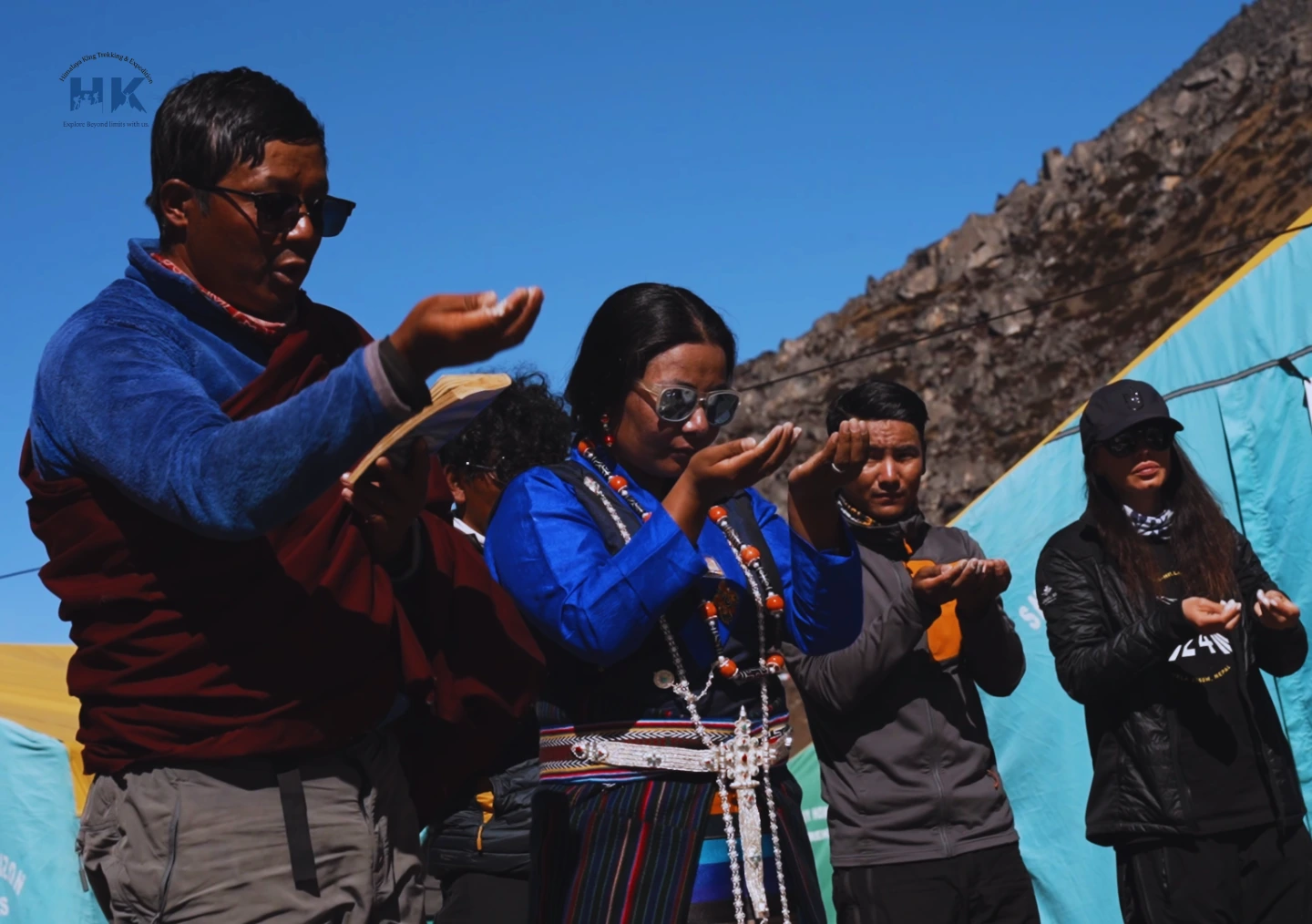
img: Group of Lama and Climbers praying with the ritual before the Ascent
4. The Transformation: Mindset and Morale Before the Climb
Lhopshu is far more than a colorful cultural show staged for foreign climbers; it is a psychological and spiritual transformation point for the entire expedition.
➢For the Sherpa Team: No experienced Sherpa guide or climber will set foot above Base Camp into technical terrain - such as the Khumbu Icefall or the Bottleneck on K2 - without completing this ceremony. It provides the spiritual armor and internal peace required to face objective hazards like serac collapses and sudden storms.
➢For International Climbers: It serves as a grounding experience that strips away ego. Throwing flour alongside the team instills humility, making climbers realize that reaching the summit depends not on their individual strength, but on nature, luck, and absolute teamwork.
➢For the Expedition as a Unit: It bridges cultural gaps. Language barriers vanish when tea is passed around and flour covers everyone's faces. It unifies the team under a single collective intent: safe ascent and safe return.
Respecting the Sacred Space
When standing before the Chorten during Lhopshu, participants are expected to show complete reverence:
➢Circumambulate Clockwise: Always walk around the Chorten and Mani walls in a clockwise direction.
➢Remove Headwear: Take off hats, beanies, and sunglasses while receiving direct blessings or flour from the Lama.
➢Be Present: Turn off mobile phones, cameras, and noise-making gear during the core chanting.
➢Treat Offerings with Respect: Never step over gear placed around the altar, prayer flags resting on the ground, or food offerings meant for the spirits.
Beyond the Summit
In a commercialized era where mountaineering is often reduced to speed records, GPS tracks, and social media updates, rituals like Lhopshu preserve the soul of high-altitude adventure.
They remind us that we are guests in the highest realm on Earth. When a team finally straps on their crampons and steps above Base Camp, they do not go as conquerors. They go with permission, protected by the smoke of smoldering juniper, the flutter of prayer flags in the jet stream, and the timeless chant: Ki Ki So So Lhagyalo.

Himalaya King
Himalaya King
Adventure Awaits — Let’s Begin Your Journey


