Every serious mountaineer who has ever walked the trail from Lukla to Everest Base Camp has stopped, looked up, and felt the pull. Ama Dablam Expedition does not blend into the Khumbu skyline; it dominates it. It's a perfect pyramid of rock and ice, the hanging glacier that gives the mountain its name, the impossibly sharp southwest ridge catching alpenglow at dusk. It is regularly voted one of the most beautiful mountains on Earth, and for the climbers standing beneath it, beauty is only part of the equation.
The other part is what it takes to reach the summit at 6,812 meters.
This is not a trekking peak with crampons. Ama Dablam is graded TD (Très Difficile) in the French alpine system, the same grade used for serious technical objectives in the Alps. The Yellow Tower. The Mushroom Ridge. Camp 2 is perched on narrow ledges with 1,500-meter drops on both sides. A summit push from the dark of a high-altitude midnight. These are not metaphors. They are the features of the standard Southwest Ridge route, and understanding each one honestly is the starting point for every serious 2026 or 2027 Ama Dablam expedition plan.
This guide covers everything: the mountain's history, the route in precise detail, the experience requirements that guides actually enforce, the cost breakdown, best seasons, permits, gear, training, and how to choose an operator. If you are genuinely planning Ama Dablam, read this before you spend a dollar.
Ama Dablam stands at 6,812 meters (22,349 feet) in the Khumbu region of northeastern Nepal, rising from the Imja Valley approximately 6 km northeast of Pangboche and roughly 7 km southeast of Mount Everest. It is the third-most-climbed major peak in Nepal, after Everest and Island Peak, but unlike Island Peak, it is not a beginner's mountain.
The name translates from Sherpa as "Mother's Necklace," ama meaning mother, dablam referring to the traditional double-pendant amulet worn by Sherpa women. The hanging glacier on the southwest face is the Dablam, the pendant visually suspended between the mountain's two ridges like jewelry. It is a strikingly accurate description of one of the most recognizable peaks on Earth.
The main summit stands at 6,812 m. A lower western peak rises to 6,170 m. All commercial expeditions target the main summit via the Southwest Ridge, the original 1961 route, and the only route with established fixed rope infrastructure.
The first recorded attempt on Ama Dablam was by a British team in 1953, the same year Hillary and Norgay first summited Everest. Edmund Hillary, after seeing the mountain's near-vertical walls, reportedly called it unclimbable. Eight years later, on 13 March 1961, his own Silver Hut Scientific Expedition changed that assessment. Mike Gill (New Zealand), Barry Bishop (USA), Mike Ward (UK), and Wally Romanes (New Zealand) completed the first ascent via the Southwest Ridge, the route that remains the standard today.
Since 1961, hundreds of expeditions have attempted Ama Dablam. The summit success rate for well-prepared climbers with reputable operators consistently runs 60–75%, reflecting the mountain's genuine technical difficulty. This is not a peak where fitness alone determines outcome.
The conventional wisdom in Himalayan climbing is a progression: trekking peaks, then 7,000-meter peaks, then 8,000-meter peaks. Ama Dablam disrupts that linear thinking entirely.
At 6,812 m, it is lower than Manaslu (8,163 m) by more than a kilometer. But technically, it is harder than Cho Oyu and comparable to sections of the Lhotse Face on Everest. For climbers whose primary interest is technical alpine climbing, rock, mixed, and ice rather than pure altitude, Ama Dablam sits in a unique position: the hardest technically rewarding climb available without the commitment of a two-month 8,000-meter expedition.
Cost: A full-service Ama Dablam expedition runs USD 5,000–9,000 with a reputable Nepali operator and USD 8,000–15,000 with an international operator, a fraction of Everest's USD 45,000–100,000.
Duration: A standard expedition runs 28–35 days, far shorter than the 55–65 days required for Everest or Manaslu.
Prestige: In the mountaineering community, an Ama Dablam summit is a widely recognized milestone. The technical demands of the route — the Yellow Tower, the Mushroom Ridge, and the exposed Camp 2 mean that summiting carries genuine credentials.
Position: Ama Dablam sits at the intersection of the Everest Base Camp trail and serious mountaineering. The approach trek passes through Namche Bazaar, Tengboche, and Pangboche, among the most beautiful valleys in Nepal. For climbers who want the full Khumbu experience alongside a serious summit, no other peak delivers it as efficiently.
This is the question most competitors in the content space answer dishonestly. Let's be direct.
Ama Dablam is not for beginners. It is not suitable for trekkers who have never used a jumar. It is not a "step up" from Mera Peak for someone with no technical climbing background. The mountain's own features will reveal this to anyone who arrives underqualified, typically at the Yellow Tower, where a 90-degree vertical granite step at 5,900 m in mountaineering boots with a loaded pack separates experienced technical climbers from everyone else.
Reputable operators require the following before accepting clients:
Rock climbing experience: Ability to climb at 5.7–5.10 (YDS) grade at sea level, with experience translating that to mountaineering boots and crampons on mixed terrain. The Yellow Tower is graded 5.5–5.8, depending on conditions. This sounds moderate, but it is in double boots, at 5,900 m, on a narrow ridge with 1,500-meter exposure below.
Fixed rope proficiency: Complete comfort ascending fixed lines with a jumar (ascender) while managing a loaded pack. Also comfortable abseiling (rappelling) on descent under the same conditions. Critically active climbing while on fixed lines, not passive hauling. Guides reject the "passive hauling" approach; you must be using hands and feet to climb while the rope provides protection.
Ice axe and crampon technique: Confident movement on 40–60 degree ice and snow slopes. Self-arrest. Front-pointing with crampons. The summit approach above Camp 2 involves sustained 55-degree snow and ice.
Multi-pitch experience: Some experience on multi-pitch alpine or rock routes, with comfort moving between technical sections over a full day of climbing.
The following prior objectives are considered adequate preparation by most serious Ama Dablam operators: Lobuche East + Island Peak combined; Aconcagua (6,961 m) with technical ascent variant; any 5,000–6,500 m technical trekking peak combined with genuine multi-pitch rock climbing experience. Prior 7,000-meter or 8,000-meter summits place you well above the minimum.
Island Peak alone is generally not sufficient as the only prior mountaineering experience. Mera Peak alone is not sufficient. Both involve glacier walking with crampons and basic fixed rope use, but neither features the vertical technical terrain that Ama Dablam's Yellow Tower and Grey Tower demand.
Before booking any Ama Dablam expedition, ask yourself: Can I lead a pitch of 5.7 rock in running shoes? Can I follow the same pitch in mountaineering double boots at altitude, wearing crampons, carrying a 10 kg pack, in minus-20°C conditions? If the answer to the second question is uncertain, that uncertainty is where the summit attempt fails — typically at 5,900 m with an entire descent still required.
Arrive honestly about your level. Good operators will assess you at Base Camp and adjust expectations or turn you back rather than put you in danger above the Yellow Tower.
The Southwest Ridge, first climbed in 1961, accounts for more than 95% of all Ama Dablam summit attempts. It is the established commercial route, with fixed ropes installed by Sherpa route-setters before each season. The route runs from Base Camp at 4,600 m to the summit at 6,812 m, a vertical gain of 2,212 m across a series of increasingly technical sections.
One important route evolution in 2026: most experienced operators now push directly from Camp 2 to the summit, bypassing an overnight stay at Camp 3. The reason is objective safety. Traditional Camp 3 (6,200–6,300 m) sits directly beneath the Dablam hanging glacier. In 2006, a serac collapse triggered an avalanche that killed six climbers at Camp 3, the deadliest single incident in Ama Dablam's history. Since approximately 2021, over 90% of commercial teams no longer sleep at Camp 3, instead making an alpine-style summit push from Camp 2, typically departing around midnight.
Ama Dablam Base Camp is one of the most pleasant in Nepal, a grassy alpine meadow with a clear stream, yaks grazing on surrounding slopes, and prayer flags marking the cook tents and sleeping areas of multiple expedition teams. It sits below the towering southwest face, with a direct view of the Yellow Tower and the ridge that leads to the summit.
At Base Camp, your climbing guide conducts multi-day training before any movement onto the mountain: fixed rope ascending, jumar technique, crampon walking on nearby rock and ice walls, ice axe arrest, abseiling practice, and emergency communication protocols. This training is not optional and should not be rushed. Most serious operators allocate 5–7 days at Base Camp for training and acclimatization before the first rotation.
The Puja ceremony is held at Base Camp before climbing begins — a Sherpa Buddhist blessing conducted by a lama, seeking permission from the mountain deity and protection for all climbers and guides. Every expedition team participates, regardless of personal religious background. This is a cornerstone of Sherpa culture and expedition ethics in the Khumbu.
From Base Camp, the approach to Camp 1 begins with a moraine walk, then gains rocky terrain along the lower Southwest Ridge. The route is non-technical initially — boulder hopping and steep scree give way to the first fixed rope sections as the ridge narrows. Camp 1 itself is positioned on narrow granite ledges with space for approximately 5–6 tents — a genuine high-altitude camp requiring careful movement outside the tent.
The acclimatization strategy involves rotating to Camp 1 and back to Base Camp at least once before attempting higher camps. This up-down-up-down pattern — climb high, sleep low — is the most effective acclimatization strategy and is built into every serious Ama Dablam itinerary.
The route from Camp 1 to Camp 2 is the technical heart of the expedition and the primary filter for climbers who are and are not ready for Ama Dablam. The climbing begins on polished granite slabs at 40–50 degrees before encountering the defining feature of the route: the Yellow Tower.
The Yellow Tower is a 15–20 meter near-vertical granite step, its distinctive brownish-yellow coloring visible from Pangboche village far below. It is the most discussed and most feared section of the Southwest Ridge for good reason.
Fixed ropes are installed on 3–6 parallel lines through the Yellow Tower by Sherpa route-setters before the season. But fixed ropes on the Yellow Tower do not reduce the difficulty to a mechanical exercise. This section requires genuine active rock climbing using hands and feet to climb the granite features, while the jumar and rope provide protection. The grade is 5.5–5.8 YDS, depending on conditions (ice on the holds makes it significantly harder). Exposure below is immediate and dramatic; a slip without the rope protection would be fatal.
Above the Yellow Tower, the Grey Tower presents a second technical challenge, mixed Scottish winter Grade III/IV terrain, before the route traverses to Camp 2.
Camp 2 itself is built on small ledges on the mountain's southwest face. Space is limited to 6–8 tents. The exposure is extraordinary, on all sides, steep terrain drops away. This is where most teams spend the final night before a summit push, and where mental composure is as important as physical fitness.
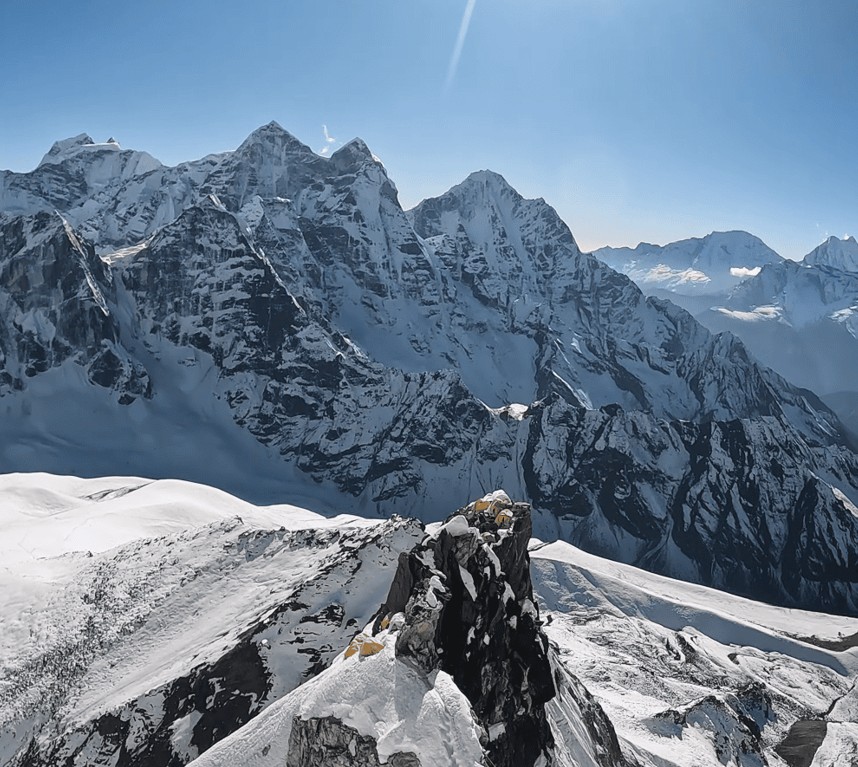
Above Camp 2, the route traverses the famous Mushroom Ridge, an exposed snow-ice arête with drops of 1,500–2,000 meters on both sides for several hundred meters of horizontal distance. The name comes from the bizarre mushroom-shaped ice formations that develop on the ridge due to prevailing wind patterns.
Moving along the Mushroom Ridge demands precise crampon placement, calm confidence in exposure, and complete trust in your technique. This is not a section where you can improve your skills in real time; it requires prior experience in a similar environment. For experienced alpine climbers, it is thrilling. For climbers who have only experienced glacier walking, this is the reason many summit attempts end here.
Traditional Camp 3 sits beneath the Dablam hanging glacier. As noted above, most modern operators use Camp 3 only as a waypoint during rotations to cache gear or take a brief rest, but do not sleep there overnight. The 2006 avalanche has permanently changed the risk calculation. Teams that maintain an overnight Camp 3 are accepting a documented, avoidable objective hazard.
Most 2026 teams depart Camp 2 around midnight for the summit push. From Camp 2 to the summit covers approximately 800 vertical meters — a demanding summit day of 10–16 hours round trip. The terrain above Camp 2 transitions from the mixed rock/ice of the lower ridge to sustained steep snow and ice as the route approaches the Dablam glacier.
The Dablam Traverse, a final knife-edge arête below the summit, is the last technical obstacle before a 30–50 degree snowfield leads to the summit. The summit itself is narrow and exposed, but the view that awaits justifies every technical difficulty of the preceding days.
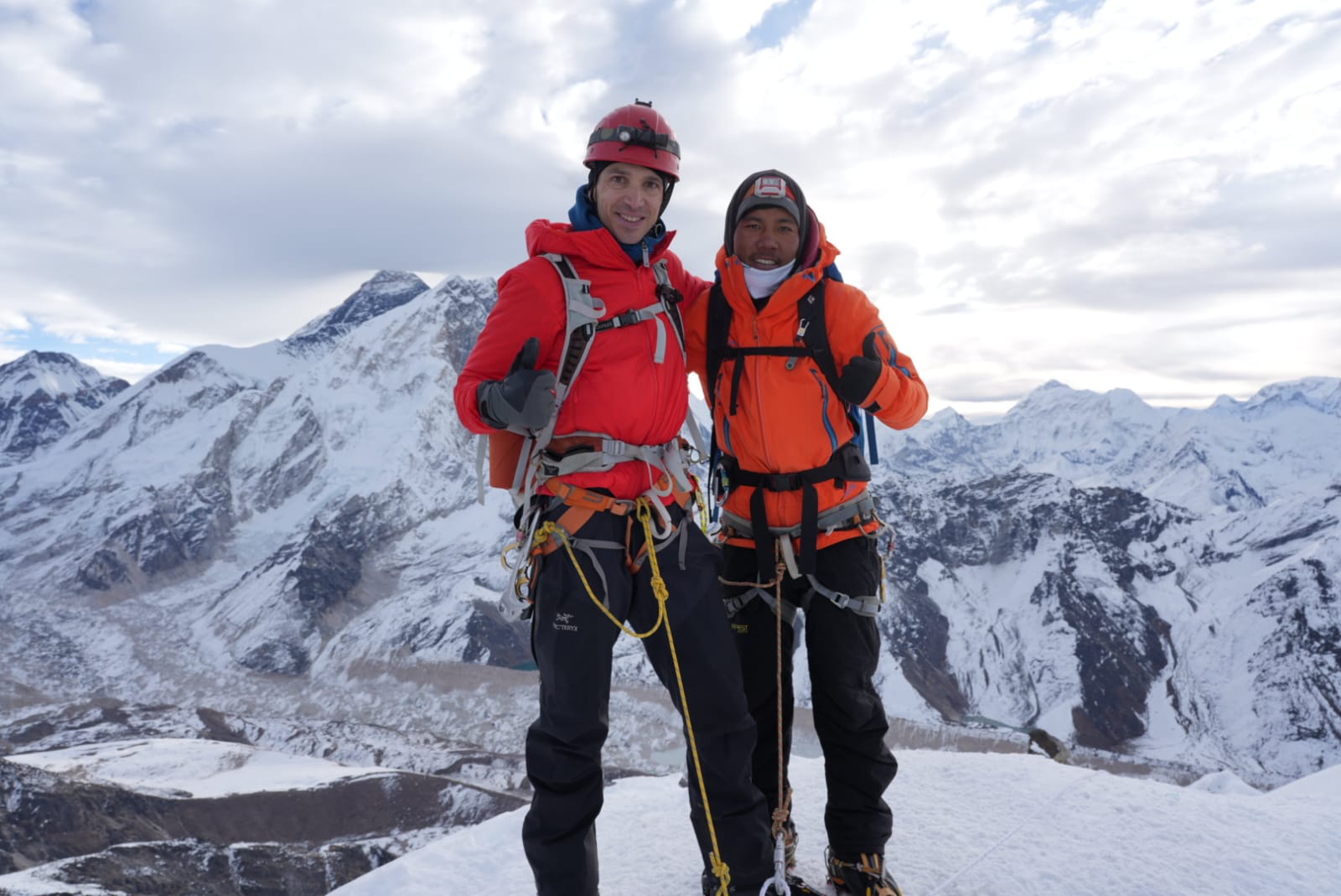
From 6,812 m on a clear morning, the panorama encompasses Everest (8,848 m), Lhotse (8,516 m), Makalu (8,485 m), Cho Oyu (8,188 m), Nuptse, Pumori, Kangchenjunga on the horizon, Shishapangma in Tibet, and the entire Khumbu region spread below in one of the most spectacular 360-degree mountain vistas achievable without an 8,000-meter permit.
The descent is as demanding as the ascent. Tired legs, depleted focus, and the technical sections of the Yellow Tower and Mushroom Ridge in descent require every bit of the technical discipline brought to the ascent. Most Ama Dablam accidents occur on descent. Move carefully, maintain rope discipline, and do not rush.
Ama Dablam sits in an unusual market position, more expensive than basic trekking peaks but dramatically cheaper than 8,000-meter objectives. Here is the honest, complete cost picture.
| Operator Type |
Package Cost |
What It Reflects |
| Budget Nepali operator |
USD 4,500–6,000 |
Basic support, smaller Sherpa team, minimal base camp |
| Standard Nepali operator |
USD 6,000–9,000 |
Full support, 1:1 Sherpa ratio on summit, solid BC setup |
| International operator |
USD 9,000–15,000 |
Western expedition leader, premium BC, small team |
| Premium/luxury |
USD 15,000–20,000 |
Helicopter to/from BC, 5-star Kathmandu, private guide |
A good standard package should include: Kathmandu hotel (3–4 nights), Lukla domestic flights, all trekking meals and accommodation, Base Camp full setup (personal tent, dining tent, kitchen, toilet), certified climbing Sherpa guide (1:1 for summit push), all fixed ropes and group climbing equipment, climbing permit, all government fees and taxes, liaison officer, and a Base Camp cook and support crew.
| Permit |
Cost |
| NMA Climbing Permit (spring/autumn) |
USD 400 per person |
| NMA Climbing Permit (winter/monsoon) |
USD 200 per person |
| Sagarmatha National Park Entry |
~USD 30 per person |
| Khumbu Pasang Lhamu Municipality |
~USD 20–25 per person |
| Liaison Officer |
Government-mandated, included in package |
The NMA permit for Ama Dablam at USD 400 is dramatically lower than the USD 3,000 charged for Nepal's 8,000-meter peaks or the USD 15,000 Everest permit, making it one of the most permit-efficient technical objectives in Nepal.
International flights, Nepal visa (USD 50 for 30 days), personal climbing gear (if not renting), travel and evacuation insurance (mandatory, budget USD 200–500 depending on coverage), personal snacks and beverages, Kathmandu extras (dining, shopping), WiFi and charging fees on the trail and at Base Camp, and Sherpa tips.
Tip your summit Sherpa after a successful ascent. The standard is USD 500–800 per Sherpa for Ama Dablam, with 10% of the total trip cost for supporting Base Camp staff. This is not optional in the climbing community — it reflects both gratitude and respect for professionals who accept personal risk on your behalf.
| Budget Type |
All-In Total |
| Budget-conscious (Nepali operator) |
USD 7,000–10,000 |
| Standard (recommended) |
USD 10,000–15,000 |
| International/premium operator |
USD 15,000–25,000 |
Unlike Nepal's 8,000-meter peaks, where spring dominates because the jet stream is the controlling factor, Ama Dablam has two genuinely excellent climbing windows.
Autumn is the best and most popular season for Ama Dablam, and October–November is the gold standard. After the monsoon clears in late September, the Khumbu settles into the most stable weather of the year. Skies are typically clear, temperatures at altitude are cold but manageable, and the post-monsoon snowpack makes certain sections of the Southwest Ridge more climbable.
October in particular sees the peak concentration of Ama Dablam expeditions, with multiple teams on the route simultaneously, which means fixed ropes are well-maintained, and Base Camp has the energy of a genuine expedition community.
November is slightly less busy and progressively colder, but many guides consider late October to mid-November the finest conditions of any season on the mountain.
Book for autumn 2026: Permit applications and operator bookings for the October–November 2026 season should be submitted by June–July 2026.
Spring is Ama Dablam's secondary season, with excellent conditions but significantly fewer teams, because most operators and Sherpas are focused on Everest and other 8,000-meter spring objectives. For climbers who prefer a quieter mountain with fewer team interactions and less crowding at Camp 2's limited tent spaces, spring is a genuinely appealing choice.
The weather window in spring is similar to autumn, stable conditions with manageable wind and temperature. However, spring can bring more snowfall on the route, making the granite sections more challenging. Route-fixing also begins later in spring as Icefall Doctor teams prioritize the Everest corridor.
Best spring months: Late April through May.
Winter Ama Dablam is a minority-sport objective, cold, with shorter days and reduced summit windows. A small number of experienced mountaineers specifically target November–December for the uncrowded conditions and the extra technical challenge of winter mixed conditions on the Yellow Tower. It is not recommended for first-time Ama Dablam climbers.
| Day |
Stage |
Altitude |
Notes |
| 1 |
Arrive Kathmandu |
1,400 m |
Hotel, team briefing, permit collection |
| 2 |
Kathmandu — gear check |
1,400 m |
Thamel shopping, permit finalization |
| 3 |
Fly Kathmandu → Lukla, trek to Phakding |
2,610 m |
35-min flight, 3-hr trek |
| 4 |
Trek Phakding → Namche Bazaar |
3,440 m |
5–6 hrs, Sagarmatha National Park entry |
| 5 |
Acclimatization day, Namche Bazaar |
3,440 m |
Hike to Everest View Hotel (3,880 m) |
| 6 |
Trek Namche → Tengboche |
3,870 m |
5 hrs, Tengboche Monastery blessing |
| 7 |
Trek Tengboche → Pangboche |
3,985 m |
3 hrs |
| 8 |
Trek Pangboche → Ama Dablam Base Camp |
4,600 m |
3 hrs, Puja ceremony |
| 9–10 |
Base Camp — acclimatization training |
4,600 m |
Fixed rope, jumar, crampon, ice axe training |
| 11 |
Rotation 1: BC → Camp 1 → BC |
5,700 m |
First touch of technical terrain |
| 12 |
Rest and recovery at BC |
4,600 m |
Equipment check, weather monitoring |
| 13–14 |
Rotation 2: BC → Camp 1 → Camp 2 → BC |
6,020 m |
Yellow Tower first attempt, Camp 2 touch |
| 15–16 |
Rest at BC |
4,600 m |
Recovery critical before the summit push |
| 17 |
Summit push begins: BC → Camp 1 |
5,700 m |
Rest at Camp 1 |
| 18 |
Camp 1 → Camp 2 |
6,020 m |
Yellow Tower, Grey Tower, Mushroom Ridge |
| 19 |
Summit Day: Camp 2 → Summit → BC |
6,812 m |
10–16 hr round trip, midnight start |
| 20 |
Contingency/rest at BC |
4,600 m |
Weather window backup |
| 21 |
Contingency/rest at BC |
4,600 m |
Second attempt window if needed |
| 22 |
Trek BC → Pangboche |
3,985 m |
Begin descent |
| 23 |
Trek Pangboche → Namche Bazaar |
3,440 m |
|
| 24 |
Trek Namche → Lukla |
2,860 m |
|
| 25 |
Fly Lukla → Kathmandu |
1,400 m |
A weather buffer day is always advised |
| 26 |
Buffer day Kathmandu (Lukla delay contingency) |
1,400 m |
|
| 27–28 |
Recovery, celebration, shopping, departure |
1,400 m |
|
Most operators build 2 contingency days into the summit window at Base Camp. Weather forecasting services provide 48–72 hour summit-zone forecasts. The guide makes the final go/no-go call based on wind, temperature, and visibility, not fixed dates.
Training for Ama Dablam is fundamentally different from training for EBC or Mera Peak because it has two components: endurance and technical skill. Both must be developed simultaneously and cannot be substituted for each other.
The baseline fitness requirement: ability to hike 6–8 hours with a 15–20 kg pack over steep terrain and recover functionally overnight. Beyond this baseline, the specific demands of Ama Dablam are:
Lower body strength: Squats, Bulgarian split squats, step-ups with a loaded pack (15 kg minimum), and leg press. The descent from Camp 2 to Base Camp after a summit push taxes the quadriceps severely.
Upper body and grip strength: Pull-ups, dead hangs, farmer's carries (both hands), and rope climbing. The Yellow Tower requires genuine upper-body pulling strength while wearing heavy gloves and double boots.
Cardiovascular base: Long hiking days (6+ hours) with elevation gain. Stair climbing with a pack twice weekly. Running or cycling 3–4 days per week. The summit day cardiovascular demand is sustained output for 10–16 hours at altitude.
Core stability: Planks, loaded carries, and balance work for movement on exposed terrain where core stability is the margin between composure and fear.
No amount of gym training substitutes for the following skills practiced on real terrain:
Multi-pitch rock climbing: At minimum 5.7–5.8 YDS routes, ideally with some experience in mountaineering boots. Climbing at a local crag or sport venue in trail shoes does not directly translate schedule sessions specifically in boots on rough rock.
Ice climbing: WI2–WI3 ice routes (or equivalent). Front-pointing on 50–60 degree ice, ice axe placements, and crampon confidence. If you have no ice climbing background, a dedicated ice climbing course (3–5 days minimum) is a non-negotiable prerequisite.
Jumar and abseiling systems: Practice ascending fixed lines efficiently — not hauling, but climbing while clipped. Practice abseiling with a loaded pack. These should be automatic movements by the time you arrive at Base Camp.
Alpine training course: An alpine climbing course in the Alps, Rockies, Cascades, or comparable range gives you exposure to multi-day technical objectives, high-altitude camping, and complex descent situations in a controlled environment before the Himalaya. Many operators offer or recommend pre-expedition workshops.
Ama Dablam gear sits between trekking peak equipment and full 8,000-meter expedition kit. The mountain does not require supplemental oxygen for most climbers under current conditions, but every other item of high-altitude technical clothing and hardware matters.
Crampons (12-point technical, Grivel or Petzl), ice axe (70 cm technical axe), jumar/ascender (Petzl or Kong), harness (suitable for mountaineering, comfortable over bulk clothing), locking carabiners (minimum 4), belay/abseil device, helmet, trekking poles for approach.
Double mountaineering boots are the standard for Ama Dablam. Single boots may be adequate in warm autumn conditions for very experienced climbers, but double boots are strongly recommended. La Sportiva G2 Evo, Scarpa Phantom 8000, or Millet Everest are appropriate. Test fit is critical, as pressure points become frostbite above Camp 1.
Merino wool base layer (thermal and moisture-wicking), mid-layer fleece, insulated jacket (600+ fill down), down expedition pants for high camp, waterproof and windproof hardshell jacket and trousers, 5-finger gloves plus liner and over-mitts. Balaclava and expedition-weight hat. Goggles (UV-rated, fog-resistant, not sunglasses).
Sleeping bag rated to –20°C for high camp comfort. The Khumbu gets cold at night even in autumn. Do not economize on sleeping system quality for an expedition requiring multiple nights at 5,700 m and 6,020 m.
Ama Dablam does not routinely require supplemental oxygen for fit, well-acclimatized climbers. However, responsible operators carry emergency oxygen in case of severe AMS, HAPE, or HACE symptoms. Ask your operator what their protocol is and whether emergency O₂ is included in the package.
At 6,812 m, Ama Dablam sits well above the altitude threshold where AMS, HAPE (High Altitude Pulmonary Edema), and HACE (High Altitude Cerebral Edema) become serious risks. The acclimatization rotations built into every professional Ama Dablam itinerary are not logistical filler; they are the physiological preparation that makes the summit push survivable.
The golden rule applies here as everywhere above 3,000 m: never ascend more than 400–500 meters of sleeping elevation per day. The BC to Camp 1 to BC to Camp 2 to BC rotation pattern is specifically designed around this rule.
Warning signs requiring immediate descent: Severe unresponsive headache, loss of coordination (ataxia), confusion or disorientation, shortness of breath at rest, persistent cough, pink frothy sputum (HAPE indicator). These symptoms at altitude are emergencies. Descent is the treatment, not rest, not waiting, not hoping. Descent.
Your operator must have a protocol for emergency evacuation. Helicopter rescue from the Ama Dablam Base Camp area is feasible — Kathmandu-based helicopters can reach the Khumbu in approximately 45 minutes in flyable conditions. Verify your travel insurance explicitly covers helicopter evacuation from this altitude and region before departing.
All Ama Dablam permits must be arranged through a registered Nepali trekking and expedition agency. You cannot obtain them independently as a foreign national.
NMA Climbing Permit: Issued by the Nepal Mountaineering Association. Cost USD 400 per person for the spring and autumn seasons. Your agency submits the application to the NMA with your passport copy, photo, and expedition details. Processing takes 7–14 days — apply at minimum 30 days before your intended expedition start.
Sagarmatha National Park Entry Permit: Required for the approach trek through the Khumbu. Checked at the entry gate at Monjo.
Khumbu Pasang Lhamu Rural Municipality Permit: A local area permit required for trekking in the Khumbu region, obtained in Lukla or pre-arranged by your agency.
Liaison Officer: The Government of Nepal mandates a liaison officer for all mountaineering expeditions. Their salary, accommodation, and expenses are the responsibility of the expedition team, typically included in the package cost.
The NMA also requires a refundable garbage deposit, ensuring all waste is carried off the mountain. Your agency handles this as part of the permit process.
The operator's decision on Ama Dablam carries more direct safety consequences than on any trekking peak, for a simple reason: on a technical mountain with 1,500-meter exposure, the quality of your guide's assessment and intervention ability directly determines whether a borderline moment becomes a safe retreat or an accident.
1:1 Sherpa-to-client ratio on summit day. On the Yellow Tower, the Mushroom Ridge, and the Dablam Traverse, your personal climbing Sherpa needs to be watching your movement and able to intervene without being responsible for another client simultaneously. Any operator offering less than 1:1 on summit day is compromising your safety margin.
NMA-certified climbing guides. The Nepal Mountaineering Association certifies climbing guides at specific technical standards. Ask for your guide's NMA certification number and verify it.
Base Camp medical protocol. What does the operator do if a client develops severe AMS at Camp 2? Who makes the evacuation decision? How is a helicopter rescue initiated? These questions should have specific, practiced answers.
Fixed ropes and equipment standards. Ask what rope specification is used for fixed lines, who installs them, and how often they are inspected during the expedition. This is not paranoid — deteriorating fixed ropes on the Yellow Tower present real danger.
Realistic summit day planning. An operator who tells every client they will summit is not operating honestly. A good operator will assess your performance during rotations and give you an honest evaluation of your summit prospects before the push. They will also set and enforce a turn-around time.
Any package below USD 4,000 for a full Ama Dablam expedition is cutting something: Sherpa quality, insurance, rope standards, or guide certification. The correlation between low price and poor safety outcomes is consistent across Himalayan mountaineering data. On a technical mountain, this correlation has life-altering consequences.
This is the most common comparative question from climbers planning their first serious Nepal objective.
Choose Ama Dablam if: You have prior technical climbing experience (5.7+ rock, ice climbing, multi-pitch), you want the most beautiful mountain in the Khumbu, you want a genuine technical challenge with serious mountaineering prestige, and you are not deterred by 1,500-meter exposure on an exposed ridge.
Choose Island Peak if: This is your first crampon-and-rope experience, you have strong trekking fitness but limited technical background, you want to combine a summit with EBC in a cost-effective package, or you are using this as a technical foundation for Ama Dablam in a subsequent season.
Choose Lobuche East if: You want a summit directly on the EBC route, you prefer less technical terrain than Ama Dablam, or you are building confidence with glacier travel and basic fixed rope technique before stepping up.
The correct sequence for someone with a trekking background but no technical climbing experience: Island Peak or Lobuche East first → genuine rock and ice climbing training → Ama Dablam. Attempting to skip this sequence on Ama Dablam typically results in a turn-back at the Yellow Tower.
Is supplemental oxygen required for Ama Dablam? No. Ama Dablam at 6,812 m does not routinely require supplemental oxygen for fit, well-acclimatized climbers. Emergency oxygen is carried by responsible operators. Most climbers complete the expedition without personal oxygen use.
How many people summit Ama Dablam each year? Typically, 200–400 people summit Ama Dablam annually in strong seasons, across autumn and spring combined. It is Nepal's third-most-climbed major peak.
Is Ama Dablam harder than Everest? Technically, in some ways, yes, the Yellow Tower demands more refined rock technique than any single section of the Everest South Col route. However, Everest's extreme altitude (8,848 m vs 6,812 m), duration (55+ days vs 30 days), and Death Zone physiology make Everest the more demanding overall objective. Ama Dablam is harder technically; Everest is harder physiologically.
Can I climb Ama Dablam if I've only done the EBC trek? The EBC trek alone does not provide sufficient technical preparation. You need prior climbing experience with crampons, an ice axe, and fixed ropes on technical terrain above the level of basic trekking peaks.
What is the best time to book for autumn 2026? Book by June 2026 at the latest. Reputable operators fill autumn Ama Dablam slots early — particularly 1:1 Sherpa-ratio slots as the Khumbu season sees strong demand. Premium operators with small team sizes fill fastest.
Can Ama Dablam be climbed in winter? Yes, but it is a serious specialist objective in winter. Shorter daylight, colder temperatures, and harder conditions on the Yellow Tower and mixed sections make it suitable only for experienced alpine climbers seeking an additional technical challenge.
Do I need to hire a guide? Yes, by Nepali law. A licensed Nepali climbing guide is mandatory for all permitted peaks. For Ama Dablam specifically, a certified climbing guide is also essential for safety on the technical sections — this is not a peak where any experienced climber should attempt to self-guide.
Ama Dablam is a finite resource. Camp 2 has space for 6–8 tents. Summit day routes the entire expedition through the Yellow Tower, a bottleneck that limits simultaneous teams. The best operators run small groups (4–8 climbers) with dedicated Sherpa support, and these groups fill months before the season.
If you are reading this in mid-2026, autumn 2026 spots with the best operators are still available, but filling. Spring 2027 is wide open and represents the optimal planning window for anyone who needs additional technical training time or wants to build a preparation objective (Island Peak, Lobuche) into the 2026 calendar before Ama Dablam in 2027.
The permit fee of USD 400 makes Ama Dablam one of the most financially accessible serious technical objectives in the Himalaya. The total expedition cost of USD 10,000–15,000 is a fraction of the 8,000-meter objectives. And the summit standing on one of the most beautiful mountains on Earth, surrounded by five 8,000-meter giants on a clear Khumbu morning, is a return on that investment that cannot be quantified.
Train for the Yellow Tower. Choose an operator with a 1:1 Sherpa ratio. Arrive at Base Camp, honest about your current technical level. And when your guide points at the summit, 2,200 vertical meters above that grassy meadow where the prayer flags are flying, know exactly what it will take to get there.
Planning your Ama Dablam expedition for autumn 2026 or spring 2027? Contact us for customized itineraries, operator recommendations, gear guidance, and pre-expedition training programs tailored to your current technical level.
|
Planning a Trip?
Get a free consultation from our travel experts with over a decade of experience.
Whatsapp US
|